
32 units of RAM 3520 Spreaders Selected for Gwangyang Port Automated Terminal Expansion
RAM Spreaders is proud to partner with South Korean engineering specialist SMH (S-Material Handling Co., Ltd.) to supply 32 units of RAM 3520 container spreaders for the Gwangyang Port Automated Terminal Phase 3-2 development in South Korea.
The project is part of a major investment in automated container-handling infrastructure by the Yeosu Gwangyang Port Authority (YGPA), with SMH contracted to deliver 32 units of fully automated rail-mounted gantry cranes (ARMGCs).
The development will feature 24 Rahmen-type and 8 cantilever-type automated gantry cranes, incorporating advanced technologies designed to support efficient and reliable container terminal operations.
Combining Engineering Expertise for the Future of Port Automation
Established in 2007 after separating from Samsung Heavy Industries’ material handling equipment business, SMH has built an impressive reputation for designing, manufacturing, and delivering sophisticated port and material handling equipment.
RAM’s involvement reflects the importance of collaboration between specialist equipment manufacturers in delivering increasingly advanced automated terminal solutions. The spreaders provided by RAM are ideally designed for high-productivity automated terminals.
The 32 units of RAM 3520 spreaders will form an integral part of SMH’s automated crane systems, supporting dependable container handling operations at Gwangyang Port.
As ports worldwide continue to embrace automation, RAM remains committed to working alongside leading crane manufacturers and engineering partners to deliver proven, reliable spreader technology.
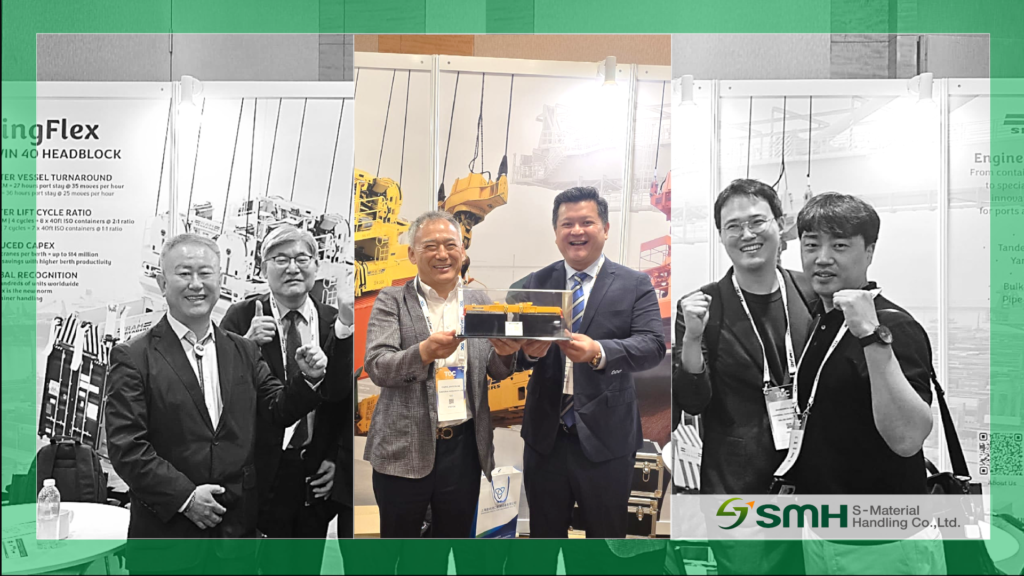
RAM’s Vice President, Keith Koh, had the opportunity to hand over a RAM twinlift scale model to SMH President Dr Chung, during the recent TOC exhibition in Singapore.
Keith said during the scale model handover “We are proud to support SMH on this significant South Korean project and look forward to contributing to the successful development of Gwangyang Port’s next-generation automated container-handling infrastructure.”